

Systems Thinking for Social Change
Learn the tools and skills to understand the complexity of the issue you care about | Summer 2026 course
-
Many people are motivated by the desire to create social impact. Yet meaningful change is often difficult because social challenges are embedded in complex systems shaped by history, incentives, and relationships. Engaging in change efforts without a clear understanding of how a system currently functions can lead to limited, short-lived, or unintended consequences.
In partnership with Kathmandu University, we are now offering a credit-bearing course on Systems Thinking for Social Change. The course gives you a structured way to make sense of complexity. It helps you understand the current state of the system, identify where change is possible, and act more strategically and responsibly. Rather than approaching “wicked” social problems as isolated or purely technical, participants examine how structures, relationships, incentives, and feedback loops interact to produce persistent patterns and outcomes.
-
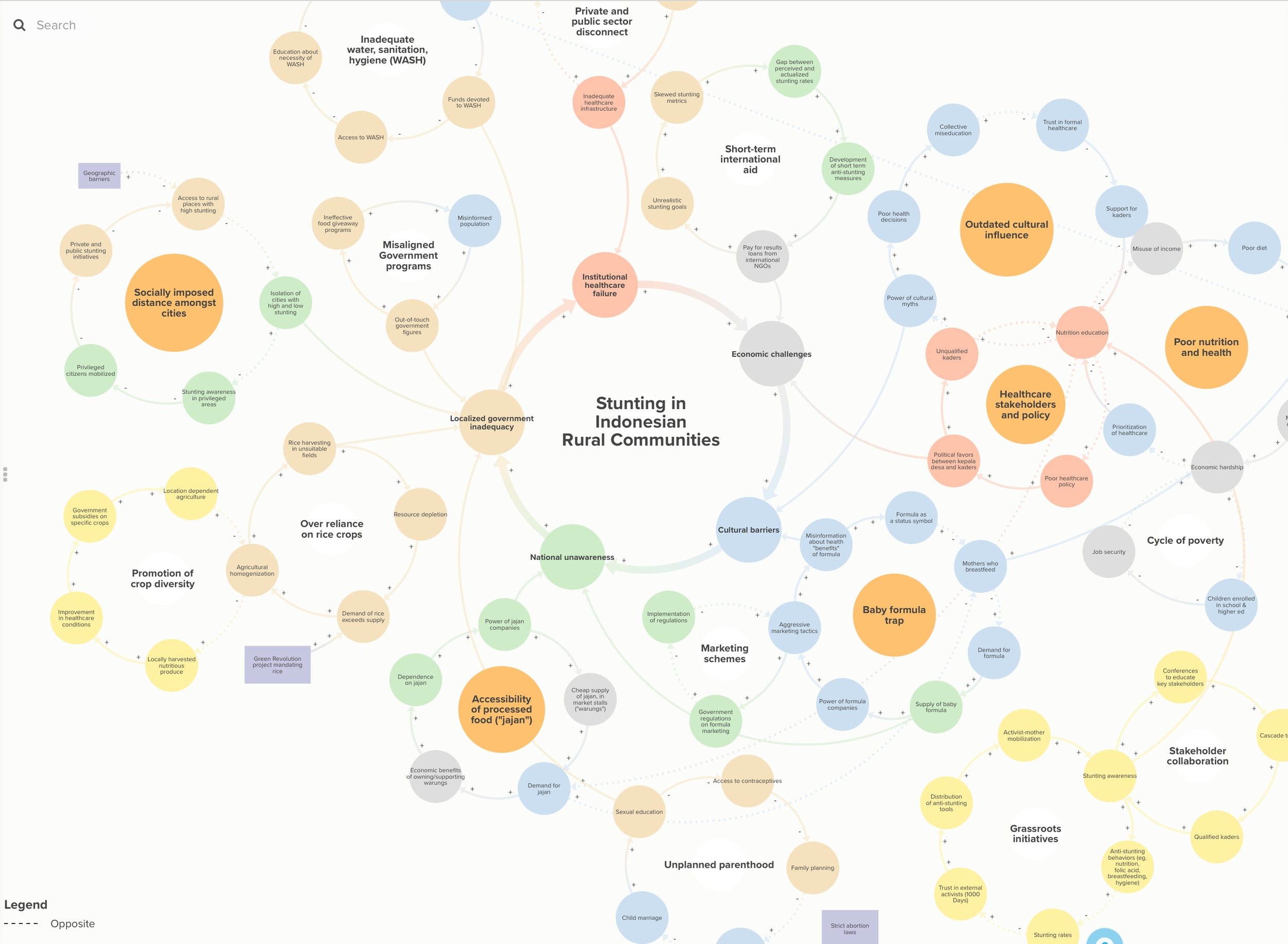
Participants work with systems drawn from organizational and community contexts, using these settings as entry points to analyze complexity and build visual systems maps (here is an example of a systems map you will create). The focus is on developing a disciplined analytical lens for understanding how systems operate, rather than on fixing problems or evaluating organizations.
Through this process, participants explore how different forms of intervention might shape a system, and reflect on where meaningful leverage may exist given real-world constraints.
Over the duration of the course, you will:Work with a social challenge/system drawn from organizational or community contexts.
Develop a clear framing question to guide your systems analysis
Build and refine a visual systems map that captures key dynamics in the system
Examine feedback loops, constraints, and unintended effects
Reflect on where leverage points may exist, and where they are best positioned to intervene given their own resources and constraints.
-
No prior experience with systems analysis or mapping is expected; the course is designed to be accessible to students from a wide range of academic and professional backgrounds.
This course is designed for students who are curious about how social challenges actually work across institutions, communities, and contexts. It is well-suited for students interested in social change, development, education, policy, or related fields, as well as those seeking a more careful, systematic, and responsible approach to complex social challenges.
The skills you learn are valuable in both the development/social impact space and broader work that requires analytical thinking, including management consulting, analytics, and strategic planning.
-
The course is designed and taught by Nimesh Ghimire and reflects more than ten years of work in Nepal. It builds on earlier courses and workshops at Swarthmore College and is informed by his graduate studies at the University of Cambridge and Systems Thinking certification from Cornell University.
-
Please fill out this short form to indicate your interest, and we will be in touch with more information about the pilot, a 4-week course during the summer of 2026.
Participant Reviews
“I thought it was very helpful to create my own systems map…it really helped me break down the different aspects of the issue I cared most about.”
“The systems map we created with Nimesh became sort of like the backdrop of what I am thinking with my project, because I feel like I had to really focus on the community needs first instead of what I was previously thinking.”
“Systems Mapping will remain one of my favorite experiences [at Swarthmore]”.